Work Packages

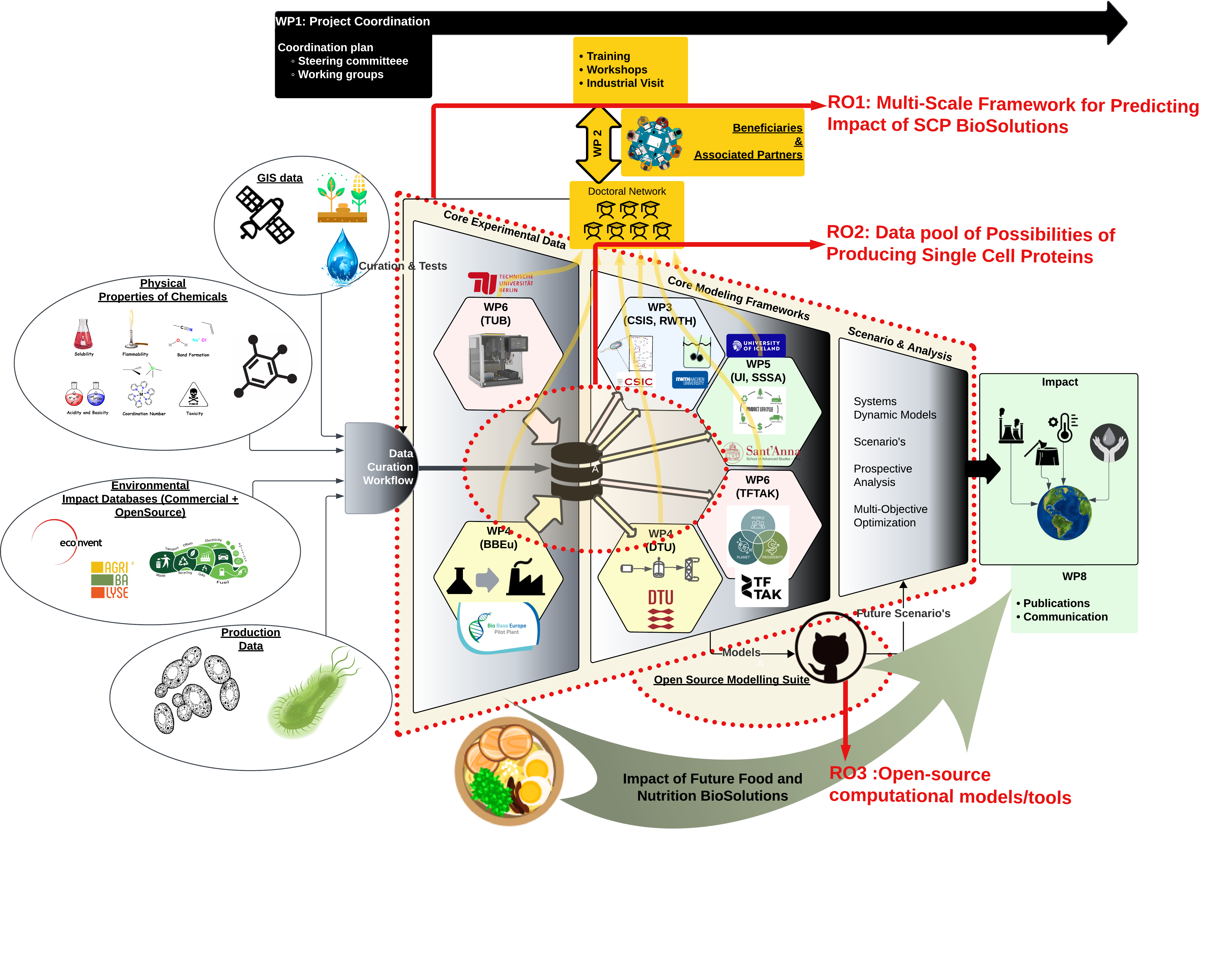
The 13 Doctoral Candidates (DCs; a.k.a. PhD students) will participate in a joint research and training program at renowned academic, research, and industrial institutions, ensuring access to state-of-the-art laboratories and industrial environments. The network will integrate expertise in synthetic biology, in-silico metabolic and bioprocess design, process systems engineering, quantitative sustainability impact assessment, and constraint-based modelling while addressing the global deployment of BioSolutions, particularly focusing on industrial applications to food and nutrition. The following Work Packages (WP) and Research Objectives (RO) together shape the Individual Research Projects for the PhD candidates in the FrameBio consortium.

The project will be coordinated and managed to ensure that tasks are executed and milestones are reached according to plan. 
All DCs will receive extensive scientific courses and transferable skills training (e.g., entrepreneurship, project management) in WP2 to ensure top-of-the-class career preparation.
Properties-guided metabolic pathway exploration to develop smart biofoundry to discover novel robust production pathways. Identifying factors causing heterogeneity in fermentation operation, influencing microbial robustness, and engineering bioreactor. WP3 will develop models to provide insights into the impact of stress and bioreactor design with the help of fluid dynamics models. WP3 will have 4 DCs.
Advanced bioprocess development and scale-up to generate SCP products using non-conventional feedstocks and production hosts. SCP products will be tested for their nutrition quality and compared to conventional benchmarks. Develop a methodology to enumerate production configurations for various fermentation modes (liquid, solid and gas fermentation) and downstream purification schemes. Deploy open-source metrics to rank SCPs (based on economic, environmental and social performance. WP4 will have 3 DCs.
Coupling high-resolution feedstock and resource information for producing proteins for food applications. WP6 will develop a novel spatial data integration with environmental impact assessment and a high-resolution water footprint predictor. Prospective Planetary Impact Assessment deploys AI-based inventory predictors to fuel LCA’s at various TRLs and extend the current planetary boundary framework with prospective assessments. The WP will deploy prospective LCA and Planetary Impact Assessment to predict future BioSolutions entailed food systems' impact on the planet. WP5 will have 4 DCs.

Integrate predictions at scale with a) real-time data at various scales of production and test optimisation strategies, b) develop and test multi-objective optimisation strategies for SCP BioSolutions. Test the data generation and optimisation framework with dynamic inputs from R&D workflows and earth’s geophysical and socio-economic data. A novel Design of Experiment (DoE) model will be integrated to the high-throughput data generation workflow to guide experimental outcomes towards more a sustainable configuration, by incorporating sustainability indicators as a KPI for optimisation targets. WP6 will have 2 DCs.

The project is communicated and disseminated by the DCs to the public, commercial stakeholders, and academic community through means and channels defined in this WP.